
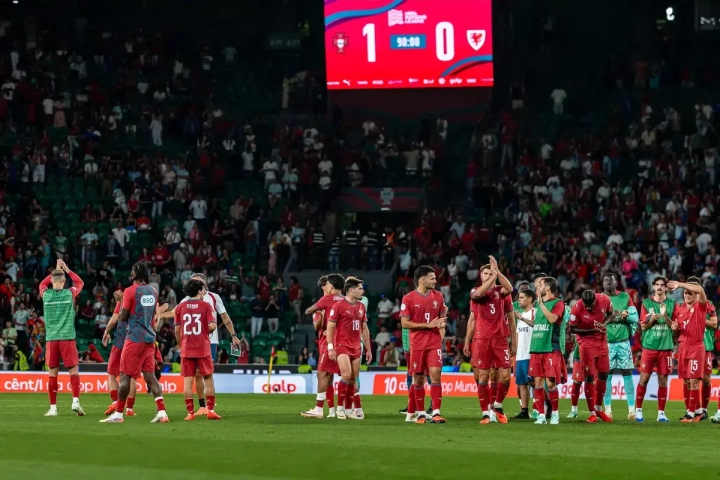
Portugal began the defence of their UEFA Nations League crown with victory on Thursday night, but Wales ensured the European heavyweights had to work until the final whistle for a 1-0 win at the Estádio José Alvalade in Lisbon.
João Félix scored the only goal of the contest after 22 minutes, his effort from outside the penalty area taking a deflection off Wales captain Ben Davies before beating Danny Ward. It ultimately proved enough to give new Portugal manager Jorge Jesus victory in his first competitive match in charge.
Yet a game that appeared for long periods to be firmly under Portuguese control almost produced a very different conclusion.
Wales survived sustained pressure, a succession of Cristiano Ronaldo opportunities and a second-half goal that was disallowed for offside before threatening to snatch a point themselves. Brennan Johnson struck the crossbar from a difficult angle and Rúben Dias produced an important intervention as Lewis Koumas and Daniel James attempted to capitalise on the rebound.
For Craig Bellamy, defeat will inevitably be frustrating, but there was also plenty within the performance to encourage him as Wales returned to the top level of the Nations League.
They arrived in Portugal facing a considerable challenge even before the first whistle. Bellamy was without several important members of his squad, including goalkeeper Karl Darlow, defender Joe Rodon and the influential Harry Wilson. Wales were therefore asking a number of players short of regular football or international experience to stand up against the reigning Nations League champions.
Portugal, by contrast, were able to field a side packed with experience at the highest level.
Much of the attention before kick-off inevitably surrounded Ronaldo. At 41, the Portugal captain was making his 234th international appearance and returned to Lisbon with his pursuit of 1,000 senior career goals providing another subplot to the evening.
Ronaldo would have opportunities to move closer to that landmark. Plenty of them.
What he did not have was a goal.
Wales began with admirable confidence rather than immediately retreating towards their own penalty area. Koumas, rewarded for his encouraging early-season form with a place in Bellamy’s starting side, looked lively during the opening exchanges, while Johnson’s speed gave Portugal something to consider whenever possession changed hands.
The visitors were willing to play when opportunities arose, although it soon became apparent that much of their evening would be spent without the ball.
Portugal gradually established control.
Nuno Mendes became particularly influential down the left, repeatedly advancing from full-back and forcing Wales deeper. Rúben Neves began dictating possession from midfield, while Bruno Fernandes looked for opportunities to release Portugal’s attacking players between and behind the Welsh defensive lines.
Ronaldo had an early sight of goal inside the opening ten minutes, forcing Ward into action, and Neves also threatened as the home side increased the pressure.
Wales were being asked to defend with discipline and concentration. Davies marshalled the back line, Ben Cabango battled through the middle and Jay Dasilva was required to deal with a constant stream of Portuguese movement.
The breakthrough eventually arrived midway through the opening half.
Mendes moved inside from the left and found Félix positioned outside the Wales penalty area. The forward struck towards goal from around 20 yards and the shot clipped Davies on its way through. That touch altered the trajectory enough to leave Ward unable to adjust, and the ball found the corner.
It was a cruel way for Wales to fall behind after the defensive work they had already put in, although Portugal’s growing territorial dominance meant the opening goal could hardly be described as unexpected.
Félix’s strike also appeared to relax the hosts.
Portugal moved the ball with greater confidence after taking the lead and Wales increasingly found themselves defending around their own penalty area. Ronaldo remained at the centre of almost everything.
The captain tried a free-kick during the latter stages of the first half but could not lift his effort beyond the Welsh wall. Soon afterwards he found space at the back post but sent a difficult left-footed volley wide.
Another opportunity followed as Ronaldo finally worked Ward from open play, although the goalkeeper dealt comfortably with the attempt.
By half-time Portugal had enjoyed the better chances and Wales had offered little threat to Diogo Costa’s goal. Cabango’s header represented their most notable first-half attempt, but Bellamy’s side had achieved something important: they were still only one goal behind.
Against a team possessing Portugal’s attacking quality, remaining within touching distance gave Wales something to work with.
The biggest escape of the evening arrived only four minutes after the restart.
Neves delivered an inviting ball across the penalty area and Ronaldo found himself with the sort of close-range opportunity he has converted countless times during his career. The goal seemed to be at his mercy, but his connection was poor and the ball flew over.
Ronaldo sank down behind the goal in disbelief.
For Wales it was another warning, but also another moment survived.
Ten minutes later Ronaldo thought his persistence had finally been rewarded.
Fernandes spotted his run and released a perfectly weighted pass behind the Welsh defence. Ronaldo accelerated beyond Cabango and finished past Ward before wheeling away to celebrate.
The celebrations did not last.
A VAR review showed that Ronaldo had moved marginally beyond the last defender when Fernandes played the pass. The goal was ruled out for offside and Wales remained alive at 1-0.
It was a significant moment in the contest.
Portugal had created enough opportunities to establish a comfortable advantage, but their failure to take them meant the match remained precariously balanced. Every missed chance increased the possibility that Wales might produce one decisive counter-attack or set-piece and leave Lisbon with an unlikely point.
Ronaldo continued searching for the goal, but his evening ended shortly after the hour mark when Jesus replaced him with Gonçalo Ramos.
He departed having attempted seven shots without scoring. His frustration was understandable. On another evening he could easily have finished with more than one goal, but Wales had survived everything the Portugal captain threw at them.
His withdrawal also seemed to alter the atmosphere of the contest.
Wales began to find slightly more space as the second half developed and Bellamy’s substitutions provided fresh energy. Kieffer Moore and Daniel James offered different attacking options, while Portugal became less relentless than they had been during the earlier stages.
Then came the moment that almost transformed the evening.
Johnson broke into space on the right and, from an extremely tight angle, managed to send an effort towards the Portugal goal. The ball beat Costa but crashed against the crossbar.
Suddenly Portugal were scrambling.
The rebound dropped invitingly and both Koumas and James attempted to take advantage, but Dias reacted superbly in front of goal to prevent Wales from converting the loose ball.
For a few seconds the Portuguese defence, which had spent so much of the evening comfortably watching its midfield and attack dominate possession, was in survival mode.
Had Wales found the equaliser, Portugal could have had few complaints about their own failure to put the contest beyond reach.
The chance also seemed to inject fresh belief into Bellamy’s players.
Wales pushed higher whenever possible and Portugal were suddenly required to defend rather than simply manage possession. Moore’s physical presence gave the visitors a target, while James provided the direct running that can make him so dangerous late in games.
Moore later sent an inviting delivery across the Portugal penalty area looking for James, but there was slightly too much pace on the ball for his team-mate to convert.
Wales continued searching.
Ampadu headed wide from a corner, while Portugal found themselves increasingly keen to protect what they already had rather than chase the second goal with the same intensity.
There remained danger at the other end, of course. Félix threatened again late on and Portugal possessed enough quality to punish any overcommitment, but Wales had succeeded in turning what had once appeared a one-sided contest into an uncomfortable final period for the hosts.
The statistics illustrated the balance of the evening more clearly than the scoreline.
Portugal finished with more than 20 attempts, while Wales managed only a fraction of that total. Ronaldo alone registered seven efforts. Yet Portugal’s inability to turn their dominance into goals ensured that one Welsh opportunity could have changed everything.
For Bellamy, that provided both encouragement and frustration.
The Wales manager acknowledged afterwards that his team had been forced to spend longer without possession than they were accustomed to. Against opponents containing some of the world’s most accomplished players, there were lengthy periods when Wales simply had to defend, remain organised and accept that Portugal would control the ball.
Bellamy nevertheless felt his players could have been better when possession was regained.
That is perhaps the biggest area he will want to address as the Nations League campaign develops. Wales demonstrated resilience, commitment and organisation in Lisbon, but Bellamy’s ambitions for the team extend beyond simply surviving against elite opposition.
He wants Wales to play.
Even after a night in which his squad had been stretched by injuries and faced opponents of enormous quality, Bellamy’s post-match message was that there is more to come. He was proud of the heart his players had shown but also conscious that they could have used the ball more effectively and caused Portugal greater problems.
That combination of pride and dissatisfaction is significant.
Bellamy was fully aware of the disparity in resources and individual quality between the teams, but he did not want those circumstances to become an excuse. Wales had gone toe-to-toe with one of Europe’s strongest squads and almost escaped with a result. For their manager, that should increase rather than lower expectations about what the group can achieve.
Captain Davies struck a similar tone.
The defender felt Wales had shown they were capable of competing at this level and was understandably disappointed that the decisive goal had come via a deflection off him. Davies also recognised Portugal created other opportunities, but the manner in which Wales remained competitive until the end reinforced the belief within the squad that they belong among Europe’s leading Nations League sides.
There were individual positives too.
Koumas produced an energetic display on an imposing stage and became increasingly influential as Wales grew into the second half. Johnson’s pace remained one of their clearest attacking weapons and he came closer than anybody in red to scoring. Dasilva endured a demanding evening against Portugal’s right side but performed impressively, while Davies brought experience to a defence missing Rodon.
Ward also deserves credit.
His recent club minutes have been limited, yet he stepped into the Wales goal in the absence of Darlow and dealt with the pressure of an evening in which Portugal continually tested the defensive unit in front of him.
For Jesus, the overriding emotion was satisfaction at beginning his Portugal reign with three points, although he accepted there remains room for improvement.
The experienced Portuguese coach was particularly pleased with the collective nature of the performance and the clean sheet. His view was that Portugal operated as a team rather than merely as a collection of gifted individuals, and he highlighted the defensive security that prevented Wales from scoring despite their dangerous late spell.
Jesus believes keeping clean sheets will be fundamental because a team that consistently prevents opponents scoring will inevitably give itself a strong platform from which to win matches.
There were, however, obvious areas for refinement.
Portugal created enough opportunities to win far more comfortably. Their movement repeatedly opened spaces in the Welsh defence and they accumulated chance after chance, particularly through Ronaldo, yet the finishing did not match the quality of the approach play.
Jesus’s decision to withdraw Ronaldo was another talking point.
Having worked with the striker previously at Al-Nassr, the Portugal coach knows him well and had strongly backed his captain before the match. The substitution was not presented as any change in Ronaldo’s importance to the team, but rather as a decision based on the stage the game had reached and what Portugal required during the closing period.
Ramos was introduced as fresh legs through the middle as Portugal attempted to maintain their intensity.
Jesus will therefore take the victory while knowing his side could have made his first competitive evening significantly less stressful.
For Wales, attention now turns quickly towards Denmark on Sunday.
The challenge of League A is exactly what promotion was supposed to provide. There will be few straightforward evenings when facing teams of the calibre of Portugal, Denmark and Norway, but the purpose is to establish whether Wales can compete consistently against nations operating at this level.
Lisbon provided an encouraging answer, even if it produced no points.
Bellamy’s team were outplayed for stretches and could easily have found themselves two or three goals behind. They were also missing important players and had limited attacking possession for much of the evening.
But they refused to disappear from the contest.
They defended, competed and waited for their opportunity. When it finally arrived, Johnson was denied by the crossbar and Dias’s intervention prevented the rebound from producing the equaliser.
Those are the margins that decide matches at this level.
Portugal ultimately deserved victory because they created substantially more opportunities and controlled long periods of the game. Félix supplied the one finish that mattered, albeit with assistance from an unfortunate deflection, while Ronaldo endured one of those extraordinary evenings when almost everything happened except the goal he wanted.
For Wales, the result will go down simply as a defeat.
The performance offered something more substantial.
Against the reigning Nations League champions, away from home, with several influential players missing, Bellamy’s side remained one moment away from taking a point until the closing seconds.
Portugal left the Estádio José Alvalade with the victory and a successful beginning to the Jesus era.
Wales left empty-handed, but with evidence that their return to League A need not be approached with fear.
The next challenge is to turn that resilience into points.