
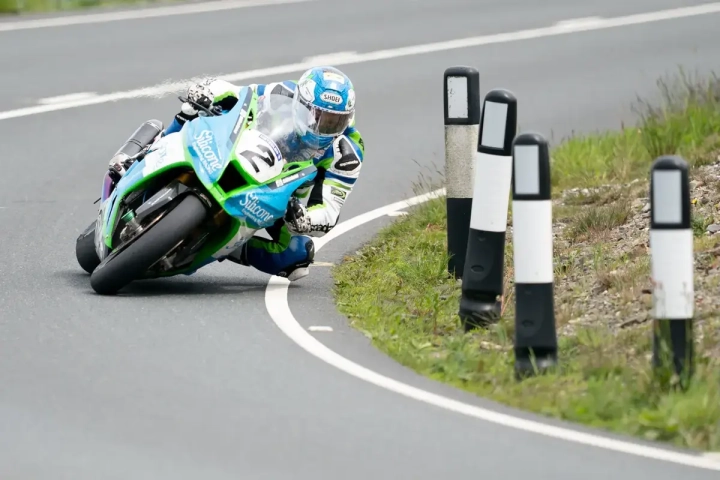
This week, the motorsport world was once again reminded of the uncompromising brutality of the Isle of Man TT. On Wednesday evening, during the third qualifying session of the 2026 event, 33-year-old Daniel Ingham from Melton Mowbray tragically lost his life in a crash at Doran’s Bend. A popular and respected rider who had achieved his dream of winning the Senior Manx Grand Prix in 2024, Ingham’s death casts a familiar, sombre shadow over the 37.73-mile Mountain Course.
STATEMENT: DANIEL INGHAM
The Isle of Man TT Races are deeply saddened by the passing of Daniel Ingham following an incident in yesterday evening’s qualifying session for the 2026 Isle of Man TT Races.
We would like to extend our deepest condolences to Daniel’s family, loved… pic.twitter.com/iY06dCrhFA
— Isle of Man TT Races (@ttracesofficial) May 28, 2026
His passing comes amidst a particularly turbulent opening week for the 2026 TT. A crash on Monday in Ramsey left eight spectators injured; Tuesday saw veteran racer Maria Costello and passenger Shaun Parker hospitalised; and by Thursday, organizers made the unprecedented decision to suspend the Sidecar class entirely following a series of severe accidents.
For outside observers, the immediate question is almost always the same: With over 270 fatalities since its inception in 1907, how does the Isle of Man TT still exist? In an era where other dangerous motorsport events, such as Group B rallying or Formula 1 at the Nürburgring Nordschleife, were sanitized or banned decades ago, the TT stands alone. Understanding why it continues requires looking beyond the casualty statistics and examining the unique legal, economic, and psychological pillars that hold the event up.
The Ultimate Test of Machine and Human
To comprehend the TT, one must first comprehend the course. The Snaefell Mountain Course is not a bespoke, sterile racetrack with vast gravel traps and impact-absorbing barriers. It is 37.73 miles of closed public roads twisting through urban villages, rural valleys, and a mountain pass. Riders navigate over 200 bends, flying past stone walls, lampposts, and pubs at speeds that defy logic. The current lap record, held by Peter Hickman, sits at an astonishing average speed of 136.358 mph.
When Formula 1 star Oscar Piastri visited the event this week, standing mere feet away from superbikes launching over crests, his reaction perfectly summarized the outsider’s view: “These guys are nuts.”
Yet, it is exactly this unsterilized danger that creates the event’s unparalleled allure. For riders, it is the absolute pinnacle of road racing, a challenge that cannot be replicated anywhere else on Earth.
Autonomy and Economics
From a legislative standpoint, the Isle of Man TT survives because of where it is held. The Isle of Man is a self-governing Crown Dependency, meaning it is not part of the United Kingdom and is free to make its own laws. Had the Mountain Course been located on the UK mainland, the event likely would have been legislated out of existence decades ago under modern health and safety frameworks.
Furthermore, the TT is the lifeblood of the island’s economy and culture. A 2018 government report revealed that the TT and the Festival of Motorcycling bring in a staggering £31.7 million to the local economy. The events attract upwards of 60,000 visitors annually, who account for nearly 40% of the island’s total visitor spending. Hotels, pubs, and local businesses rely on the two-week festival to sustain them through the year. Culturally, the race is deeply woven into the Manx identity; taking the TT away from the Isle of Man would be akin to taking the Carnival away from Rio.
The Consent of the Competitor
Perhaps the most crucial factor in the TT’s continuation is the nature of the competitors. No one is forced to race the Isle of Man. It is not a mandatory round of the MotoGP championship, nor is it required to have a successful career in track racing.
The entry list consists of highly experienced, specialist road racers who must pass rigorous eligibility checks. They are consenting adults who are intimately aware of the grim statistics. As RAF serviceman and TT racer Michael Russell noted in a previous interview: “Everyone enters the races with the knowledge of this happening… it’s a risk that we all take. I’ve seen first-hand the risks involved with the Isle of Man. It’ll never stop me doing it.”
In a heavily regulated modern world, the TT remains one of the few arenas where individuals are granted the ultimate freedom to test their limits, even at the risk of their own lives. It is a philosophy that views the pursuit of extreme passion as a fundamental human right, drawing comparisons to extreme mountaineering. Just as climbers accept the “death zone” on Mount Everest, road racers accept the perils of Bray Hill.
A Proactive Approach to Safety
Despite its reputation, the event is far from unregulated. The organizers implement rigorous safety protocols that evolve year on year. The suspension of the Sidecar class for the remainder of 2026 proves that officials are willing to halt racing when the risk crosses an unacceptable threshold.
Veteran motorsport journalists point out that in many ways, the TT’s medical and safety responses are highly proactive. The event employs over 600 volunteer marshals, elite rapid-response medical teams via helicopters, and highly trained travelling marshals on superbikes. Protocols regarding concussions, rider mental health, and crash-scene management are continually updated to mitigate as much risk as humanly possible without fundamentally altering the nature of the course.
The Paradox Continues
The Isle of Man TT is a profound paradox. It is simultaneously beautiful and tragic, awe-inspiring and devastating. The loss of Daniel Ingham is a heartbreak for his family, friends, and the tight-knit road racing community.
Yet, as long as there is an autonomous island willing to host it, an economy that thrives on it, and a breed of men and women who feel compelled to stare down the ultimate physical and mental challenge, the Isle of Man TT will continue to run. It remains the last bastion of a bygone era of motorsport; a controversial, magnificent, and lethal testament to human free will.