
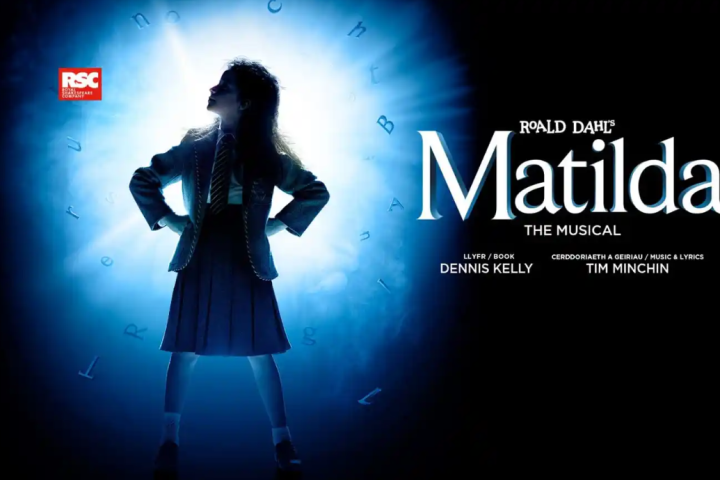
Celebrating 15 years of Matilda The Musical, the acclaimed Royal Shakespeare Company production is coming to Wales Millennium Centre this December and January. We caught up with Daniel Evans to talk about bringing the award-winning musical to Cardiff, his Welsh roots, his career and the enduring magic of theatre.
How do you feel about bringing Matilda to Cardiff, and what makes this production so special?
First of all, the show has just celebrated its 15th anniversary in the West End, and to have a show that has lasted this long and maintained such a high standard in the West End and on tour, not just in Britain but having just completed its third tour in China, and with Australia coming up next year, is a sign of a wonderful production, with very special performances, music and direction.
I saw the show recently, and it’s a production that brings so much fun and joy to people. It has a strong theme about a girl who, through her own imagination, can change the story of her own life. So that’s the first thing: it’s a very special show, and I feel incredibly proud that this production by the Royal Shakespeare Company is coming to Wales Millennium Centre.
Of course, there’s also a connection between Roald Dahl and Wales, because Roald Dahl lived in Llandaff for a while. Thirdly, as a Welsh-speaking Welshman, it’s lovely for me to see this show coming to the capital and for audiences in Wales to be able to enjoy such a high standard of theatre.
How have your Welsh roots and your upbringing in the Rhondda helped shape you as an artist?
My roots are fundamental to who I am. That means growing up in the Rhondda, going to chapel with my auntie, Auntie Doris, and competing in countless Eisteddfodau from the time I was a little boy. Doing drama at school and then going to the Guildhall for my training, but in many ways, it was almost like an official nursery for all of that.
I feel incredibly fortunate to have been brought up in that tradition, where I’ve been able to learn and sing and recite pieces of poetry in front of people since I was a little boy. I can still remember those pieces of poetry now, which is quite extraordinary when you consider that I’m in my fifties.
The main part of my job here at the RSC is creating situations where artists can tell stories to audiences. In a way, that’s the golden thread that runs between my childhood and where I am now. I’ve been practising storytelling through poetry and songs since I was a child, so I feel incredibly indebted to that upbringing and incredibly fortunate.
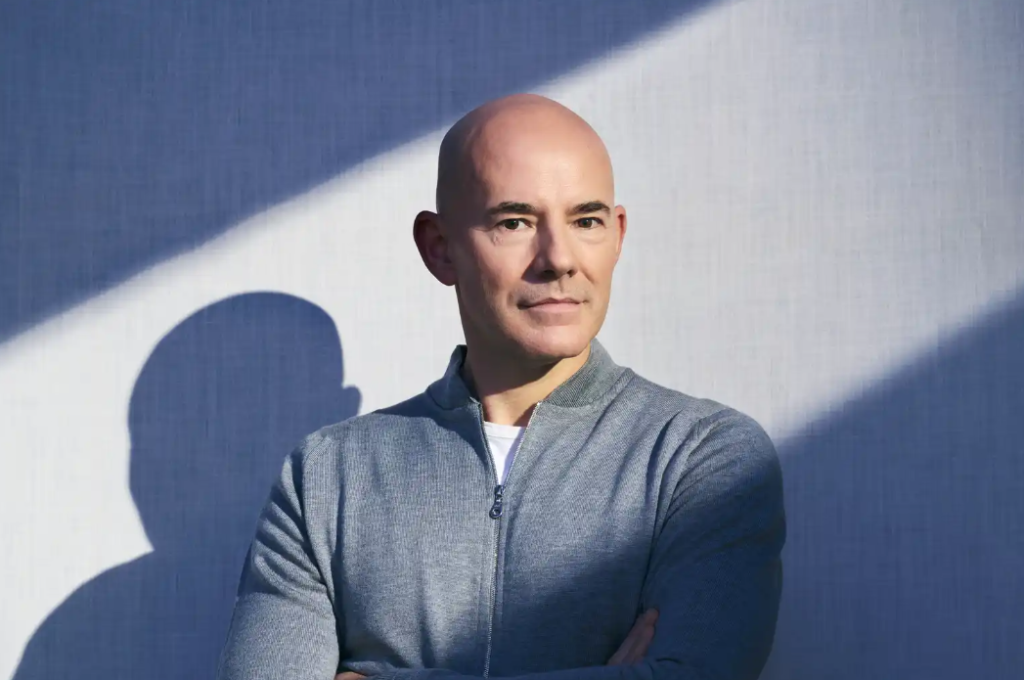
Daniel Evans
Matilda
Roald Dahl is a master storyteller. Why do you think audiences continue to connect so strongly with the story of Matilda, and particularly with the musical?
To begin with, it’s the songs. You can’t help singing them for weeks after seeing the show because they stay in your head. Tim Minchin himself is a master songwriter, and his score is genuinely exciting.
Then I have to say that the story itself is about this young girl who perhaps isn’t having a very good time at home, but she finds a teacher who believes in her, and through the power of her imagination she’s able to change her future. So, there’s something at the heart of the play that tells us and shows us just how important imagination is, in allowing us to imagine a better life and better worlds.
It’s an important theme, particularly perhaps when you consider how young girls are still treated, both here and abroad, in terms of their education and the way society deals with them.
And I would also say that there’s so much humour in the show, and that humour is something we’re all familiar with and can all relate to. It’s a show that the whole family can enjoy together, and so it’s been lovely to see three generations within one family enjoying the show at the same time.
There are many reasons why this magic has captured people’s imaginations.
Has there been a teacher who has had a particularly significant influence on you and helped shape your career?
A teacher who changed my life was Patsy Rodenburg. When I went to the Guildhall, she was the voice teacher and my Shakespeare teacher.
As it happens, Patsy Rodenburg now works with me at the RSC as Director of Voice Emeritus in Stratford, so she’s someone who’s been alongside me throughout my journey, and she’s genuinely inspirational.
What is it about the RSC that makes you feel so at home there, and what is it about the company that makes your heart sing?
There are two things, really.
The first is the work of the writer in the title, Shakespeare. The word genius is overused, but having just directed As You Like It here in Stratford, on stage, you simply know when you’re hearing these words over and over again in the rehearsal room and watching actors get to grips with his work that there’s no doubt in my mind that there’s something almost divine about him.
I don’t know where that gift came from. He was a country boy, he didn’t go to university and he was an actor, so that’s another connection I have with him.
But somehow he had that extraordinary genius, and these plays, which are over 400 years old, are still speaking to us and taking us into something deep within our humanity and our identity. We’re still learning something from his work, about all sorts of things, love for example.
Secondly, the Royal Shakespeare Company doesn’t just do Shakespeare. We also produce musicals such as Matilda and Les Misérables. Les Mis began at the RSC.
We also produce new plays, and that’s something I find incredibly enjoyable because you get to give living writers and playwrights the opportunity to stand shoulder to shoulder with Shakespeare himself.
So there’s something about that dialogue between living playwrights and a playwright who died 400 years ago, and that conversation between them is something that really excites me.
How has your role as Artistic Director of the RSC challenged and stretched you, both creatively and personally?
Working on Shakespeare always stretches your brain. You have to understand what society was like 400 years ago. We had to do a huge amount of research into what happens to the body, for example, when you fall in love. So the artistic side of the job is always stretching you.
But in terms of the other side of the role, so to speak, we have more than 700 permanent staff, and then we work with over 1,000 freelance people every day. So it’s a challenge to make sure that all those people are travelling in the same direction, and to make it clear and certain to everyone what the purpose of the RSC is and why we’re here.
The challenge is making sure that Shakespeare’s work, the world of theatre, going to the theatre and enjoying plays remain relevant to our everyday lives.
How have audiences changed over the years, and how is the RSC adapting to new challenges, particularly when competing with the digital world, phones and streaming services?
One of the things I’m proud of with As You Like It, for example, is that 40% of the audience were new audiences who had come to see the show. These were people coming to the RSC for the first time.
With Game of Thrones, a production we did in the summer, an adaptation of the work of George R. R. Martin – Game of Thrones: The Mad King, a new play based on George R. R. Martin’s novels, adapted by Duncan Macmillan and directed by Dominic Cooke – 57% of the audience were people coming to the RSC for the first time.
So literally, the audience is new to us. They’re coming to us for the first time, and that’s exciting.
But what we’re also discovering about audiences is that, as AI develops and with these platforms where we can watch whatever we want, whenever we want, what we’re finding from the feedback is that the experience of seeing something live is becoming more and more precious to people.
People are craving the opportunity to switch off their phones and escape from the world for two or three hours. And with Game of Thrones, it was a four-hour show, and people wanted to come and see it again!
There’s something about the experience of being part of an audience. This magical thing happens where we all go in as individuals, but in a way, we come out as one entity. We’re all focused on the same story, without our phones, without the outside world interrupting us.
We’re all laughing at the same time and crying at the same time. There are studies now that have shown, for example, that when we sit watching a play and experiencing something together, our hearts beat in the same rhythm as we watch it.
Our hearts beat faster as the story in the play speeds up, and slow down as the play slows down.
So there’s something that brings us together as an audience and as a society. And that’s interesting when we have so much choice, and when that choice is often something digital. This live experience is becoming more and more precious to people.
Looking back over your career, which collaborations or artistic experiences have been the most inspiring and memorable for you?
One of the great pleasures and privileges is getting to meet artists from all over the world who want to create new work, work that they’re passionate about. Their hope is that their work will contribute something to the world we live in today.
For example, the pleasure of working with Thom Yorke, the lead singer of the band Radiohead. We have a production called Hamlet Hail to the Thief, a production that combines Shakespeare’s tragedy with reimagined pieces from Radiohead’s album Hail to the Thief.
The concept was developed by directors Christine Jones and Steven Hoggett, with Thom Yorke reworking the album to create a new musical score that’s performed live on stage.
It’s happening at the Barbican this October, and it sold out when we did it in Stratford last year.
So getting to meet these contemporary artists who see the value in Shakespeare, and who see the value in coming somewhere like Stratford to create new creative work that will add to our enjoyment but also to that wider public and social conversation that’s taking place, is what inspires me most.
What makes the RSC’s production of Matilda so special, and how do you think it has influenced the world of musical theatre?
What’s interesting is that when Matilda opened in Stratford, the score felt like something genuinely new because it was Tim Minchin’s voice and his unique humour coming through the characters.
Perhaps this has led to several other musicals where a composer or writer has wanted to put their own personality into the score or the dialogue.
So it’s interesting to see how Matilda has influenced the musicals that have followed it and how it has helped develop the form of musical theatre.
For example, what is it like to have a child, a young actress, leading us through the entire evening, as of course happens with Billy Elliot too?
The training these young girls go through in order to perform in the show, to keep themselves fit throughout the run, and to look after themselves in terms of their mental and physical health during the production, is incredibly thorough.
There’s a huge amount of work that goes into it. The people who train them, rehearse with them and look after them are wonderful.
After all these experiences and achievements, where do you feel you are on your journey as an artist and creative leader?
I’m still learning. I don’t feel that I’ve reached the end of my learning journey at all. I’m still learning.
I feel that directing and acting feed into one another, so it’s always helpful to have been an actor because you have to be able to trust your director and trust your fellow actors.
It’s also a good experience to understand what good actors have to put themselves through in order to create a performance. And then, when I come to directing, that gives me a certain insight into an actor’s life and an actor’s process.
That means you can be patient, you can champion their work, and you can give direction in a way that is mindful of the vulnerability they have to deal with.
If you had told me when I was a 15-year-old boy that one day I’d be running the RSC, I would have laughed.
I wouldn’t have believed it for a moment. These things happen gradually. They’ve happened gradually for me.
I trained as an actor for 15 years, and then I started directing. After being in America, acting in New York, the journey changed. I got a job as Artistic Director at the Crucible in Sheffield, where I spent seven years.
Then I moved south to Chichester to become Artistic Director at Chichester Festival Theatre for seven years, and then came to the RSC. So one thing has followed another.
I had a sort of philosophy when I was starting out, which was simply to say yes to every opportunity that came my way. People would ask me to do things and I’d say yes. I very rarely said no.
People often ask me what we would say to young people. Say yes. That’s what we’d tell them.
Opportunities don’t always come along very quickly. I’ve been fortunate. There weren’t many periods when I was out of work, and I know that’s a very rare experience for a lot of people.
I was lucky, but it’s hard to believe when I look back. I just feel as though I’m somehow only beginning the journey.
Looking back on your career, which experiences and people stand out as having had the greatest influence on you?
So many people.
Working with Peter Gill, for example, who sadly died recently, was a real highlight. He was a playwright and director from Cardiff. Peter taught me so much about language, and about an actor’s energy and directing.
Working with Stephen Sondheim – I was fortunate enough to work with him twice on a couple of his musicals. And talking about genius, just being able to collaborate with him and learn from him was wonderful.
Patsy Rodenburg is an influence and an inspiration in my life.
There are so many people and actors. Ian McKellen is someone I’ve admired since I was in my teens. He’s someone I’ve worked with and have stayed in touch with on several occasions – far too many people to name.
I feel so fortunate to have been in a position where I’ve been able to work with these people.
There’s also a new generation of people who inspire me now. The young artists I meet and work with today continue to inspire me because things are constantly moving forward, and these young people keep me on my toes.
What can audiences expect when they come to see Matilda at Wales Millennium Centre over the Christmas period?
A wonderful night of theatre, an evening full of humour and emotion, a good story and relevant themes.
But above all else, just fun.
Matilda the Musical – Wales Millennium Centre 9 December 2026 – 17 January 2027